What it does
Known as "Reading Time" for static assets and "Enough Time to Read" for videos, this KPI quantifies the time it takes a person to read the text in a marketing asset. For static assets, it calculates the time it takes to read the text in the asset, while for video, it assesses whether there is enough time to read the text in each scene that contains text.
Why it matters
In an attention economy with limited consumer focus, it is critical to ensure that marketing messages are read quickly and easily. A shorter reading time suggests simplicity and clarity, which increases message efficiency and effectiveness. This is especially important in advertising and packaging design, where quick comprehension can have a significant impact on consumer behavior. Understanding time to read also helps optimize marketing assets and improve the overall customer experience.
How it works
It is known that an adult human can read approximately four words per second on average. Using a text recognition model, we first extract the number of words in a given asset (per scene in videos). Dividing the number of detected words by four gives an estimate of the time required to process the image text. For videos, we detect all scenes along with their reading time and compare them to their respective durations to determine if there is enough time to read. The overall score indicates the proportion of scenes where the text can be read adequately.
How to achieve great results
The illustration shows sample images with increasing amounts of text and the corresponding predicted reading times (in seconds).
-
Focus on concise and clear messaging in your marketing assets to reduce reading time while maintaining message effectiveness.
-
Optimize text size and contrast to improve readability, especially in video content where read time is limited by scene length.
- Limit the amount of text in each scene or asset and prioritize key messages to ensure they are quickly understood by viewers.
-
In video content, adjust the pacing and duration of scenes to give viewers enough time to comfortably read and understand the text.
AI models used
The process uses a world-class OCR model to extract texts from assets, capable of recognizing a wide range of fonts and styles in diverse visual environments For videos, a scene detection model is used to detect scenes to ensure that the text is readable within the duration of a scene.
Science background
Reading rate
There is a large literature on how many words humans can read in each amount of time. In a review of this literature, covering 190 studies (18,573 participants), Brysbaert (2019) estimates that the average silent reading rate for adults in English is 238 words per minute (wpm) for non-fiction and 260 wpm for fiction. The difference can be predicted by considering the length of the words, with longer words in non-fiction than in fiction. Thus, the upper limit in reading time of a given text is about 4 words per second in non-fiction.
Why can we not read faster? When we read, we make a sequence of fixations (brief time periods during which the eyes stand still) and saccades (eye movements to new parts of the text). The text information we can extract during a fixation is limited and we need time to move our eyes. Both factors constrain the information that can be extracted from a text in a given time period. Skilled readers move their eyes during reading on the average of every quarter of a second. Only when the eye is fixed, new information is processed.
When we read your eyes make fixations, during which information is brought into the brain. At any given fixation point, we can process about 4-5 characters with maximum acuity. (c) https://en.wikipedia.org/wiki/Eye_movement_in_reading
Reading time in marketing assets
Reading times for advertising and other marketing touchpoints have long been known to be in the range of a few seconds, with decreasing trends. For example, reading times of emails in email marketing has been decreasing from ~13 seconds in 2018 to 9 seconds in 2022 (see figure). Almost a third spent less than 2 seconds per Newsletter and almost half just “glanced” at the newsletter, with reading times between 2 and 8 seconds.
Reading time with marketing newsletters.
(c) Litmus “Trends in Email Marketing”
Similarly, viewing times for print advertisements have been measured to be in the range of two to three seconds (Ketelaar et al., 2008).
The following figure shows predicted reading times for 50.000 static assets (English):
- The shape is that of a negative exponential distribution, suggesting the most assets have low reading times
- 25% of assets have reading time of 3 seconds or less
- Median (50%) is 7.4 sec
So many ads have more text that can be read within the 2-3 seconds that the average viewer spends viewing them. This makes reading time prediction a valuable metric to quantify the expected reading time of the text in a given marketing asset.
Influence of language
TL;DR: Cognition—not language—appears to control the rate at which we communicate/read
Differences in average word length and other aspects of the English language may imply that the wpm estimates discussed so far are to some extent English-specific, given that they are based predominantly on studies in English. English's average word length is influenced by its extensive use of short function words like prepositions (at, between, in, of, ...), pronouns (anybody, he, I, it,...), determiners (a, more, that, the, ...), conjunctions (and, because, or, when, ...), auxiliary verbs (be, do, get, go, ...), and particles (as, no, not, ...). These words, numbering about 250, significantly lower the mean word length in English texts—5.9 letters in fiction and 6.7 in non-fiction. In contrast, languages lacking function words like Chinese, Indonesian, and Russian, which also have fewer prepositions due to case marking systems or use fewer pronouns, tend to have shorter word lengths and different reading rates.
In analysis by Twitter (now X) it was found that most Tweets in Japanese have 15 characters, while most English tweets have 34 characters.
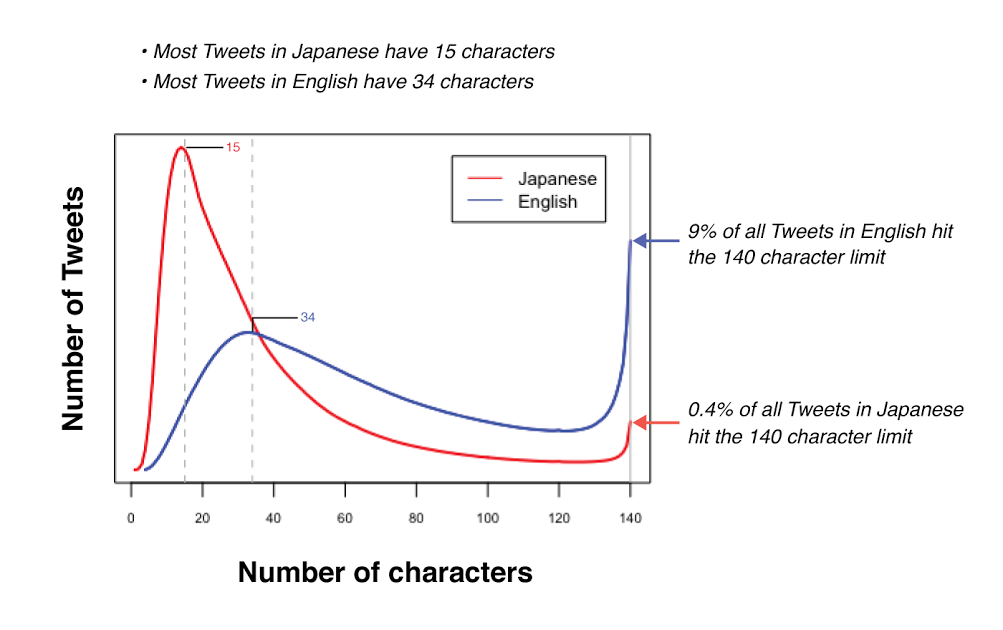
The same tweet in different languages results in different character counts per language:
Because languages express ideas with different numbers of words of different lengths, it has been proposed that it is better to look at the information transmitted in a text rather than the number of words used. Indeed, there is evidence that reading times across languages are equivalent when text messages are matched (Liversedge et al, 2016). For example, when reading times are compared for non-fiction paragraphs (Wikipedia articles) in Hebrew and English, reading times per paragraph do not differ significantly between the languages, despite the differences in number of words and word lengths.
Chinese words tend to be short on average—only 1.5 characters per word, compared with 5.1 letters per word for English. Chinese’s high information density could work for it—more complexity could impart more meaning per glance— or against it—each character could require a longer stare to decipher. The answer is neither.
English and Chinese are, by and large, read at the same speeds. In one study, both languages were read at approximately the same rate—English at 382 words per minute and Chinese at the equivalent of 386 words per minute. A statistical tie. Another study found the percentage of times a person moves backward in a text—a sign the person is having trouble processing the words—to be about the same for English and Chinese.
Learn more:
Sources:
- Brysbaert, G. et al. (2019), How many words do we read per minute? A review and meta-analysis of reading rate. Journal of Memory and Language. Volume 109
- Ketelaar, P., van Gisbergen, M.S. and Bosman, J. (2008). Attention for Open and Closed Advertisements. Journal of Current Issues & Research in Advertising 30(2)
- Litmus (2022). Trends in eMail Marketing Report.
- Liversedge, S. P., Drieghe, D., Li, X., Yan, G., Bai, X., & Hyönä, J. (2016).Universality in eye movements and reading: A trilingual investigation. Cognition, 147, 1-20.
- Lott, L. A., Schneck, M. E., Haegerström-Portnoy, G., Brabyn, J. A., Gildengorin, G. L., & West, C. G. (2001). Reading performance in older adults with good acuity. Optometry and Vision Science, 78(5),316-324.
- Rayner, K., Schotter, E. R., Masson, M. E., Potter, M. C., & Treiman, R. (2016). So much to read, so little time: How do we read, and can speed reading help? Psychological Science in the Public Interest, 17(1),4-34.
- Sun F, Morita M, & Stark LW (1985). Comparative patterns of reading eye movement in Chinese and English. Perception & Psychophysics, 37 (6), 502-6
- Sun, F, & Feng, D (2010). Eye movements in reading Chinese and English text Reading Chinese Script: A cognitive analysis, Eds. Jian Wang, Albrecht W. Inhoff, Hsuan-Chih Chen., 189-205
- Yan, G., Tian, H., Bai, X., & Rayner, K. (2006). The effect of word and character frequency on the eye movements of Chinese readers British Journal of Psychology, 97 (2), 259-268